As the cost of material goods, such as basic clothing or bread, has fallen far below its average cost in the early 20th century, at least in the global north, due to industrialisation, we see an equal movement against these commodities, at least in terms of social cache. Mass production removes the necessity for the worker to understand the commodity in its totality, as only the knowledge of the particular element they are designated to produce is necessary. Similarly, on the side of consumers, there is less of a necessity to understand the nature of the commodity. There is much less of a compulsion to know how to sew buttons back into their place or even polish a shoe, if an identical copy of the product can be purchased at similar cost to the sewing kit or tin of polish, not to mention, the time saved by doing so. Similarly, there is no need to know how to bake bread if it can be bought at a similar price to a bag of flour and yeast. But what we see here is a movement where luxuries which were usually restricted to the domain of the wealthy classes, not the luxury of goods themselves, but the luxury, and badge of privilege, of not needing to know how to perform these “acts of necessity”. By “acts of necessity” I refer to generally domestic tasks performed for the sake of being able to continue everyday life, such as maintaining clothing and producing food from scratch. But where these acts of necessity have been displaced by industrialisation and mass production, meaning, the knowledge of craft is supplanted by ever cheaper essential goods, they do not disappear. We find that the signifying role of acts of necessity has gone through an inversion. What was once an act that was necessary for the simple reproduction of daily life, of eating and clothing oneself, has now become a signifier of luxury.
By this I refer to the widespread trend and resurgence of “craft”. Whereas once “make do and mend” referred to the necessity of craft to maintain a standard of living in everyday life, a material necessity, craft has now become a class indicator, a social frivolity. There is a desire to return, rather than a return to desire. Everywhere we see the images of pre-industrial society returning, like childhood echoes in our dreams. But, as noted in Milan Kundera’s “The Joke”: “All the basic situations in life occur only once, never to return.” We cannot return, and yet, we are compelled to try by our fantasies. We have moved past the “honeymoon period” of cheap consumer goods and are unconsciously driven to return to what was before. But this, in many cases, was mere drudgery. Yet a choice between the drudgery of domestic labour and the dissatisfaction of cheap consumer goods leaves us at an impasse. So we seem to find those artisans of 1871 returning in a new form, as the neobakery. What was once the cheapest and most base form of sustenance, bread, returns as an item of luxury, in esoteric and expensive forms. Even husbandry has returned, of course, no longer as material necessity, but as vicarious enjoyment. A week of working on a farm was (and still is for many) a means to subsist day-to-day, but now, that labour time is not just simply exchanged for wages, but rather, wages are exchanged to perform that labour free of charge, in the forms of “experience” holidays.
The other concurrent movement in conjunction with this is the accessibility of what were once luxury goods. The cartoonishly bulky cell phone of the 1980s was the classic symbol of the wall street investment banker, perfect for those who wish to flaunt both their wealth and practical mindset. But, compared to the modern smartphone, its capabilities were shockingly rudimentary. Yet the smartphone is not necessarily a luxury good – possessing one is increasingly essential in both domestic and work life. Even the most underpaid, overworked zero hours contract retail or service worker will be expected to have one for the sake of taking photos to post on the company’s social media or looking up information for customers. What was once a social signifier for the select few becomes a material necessity for all. Even using public transportation, accessing healthcare or looking up municipal information becomes difficult without it. The trend even stretches beyond necessity and into social signification once more, like that of the 80s cellphone, but in the form of negation: only those who are particularly privileged can afford the luxury of “logging off”, knowing that, in abstaining from using their phone, they won’t miss an essential call which for others could be: the utilities cutting off their electric, debtors who will send their bailiffs or a doctor’s appointment, sorely needed and overdue, now lost.
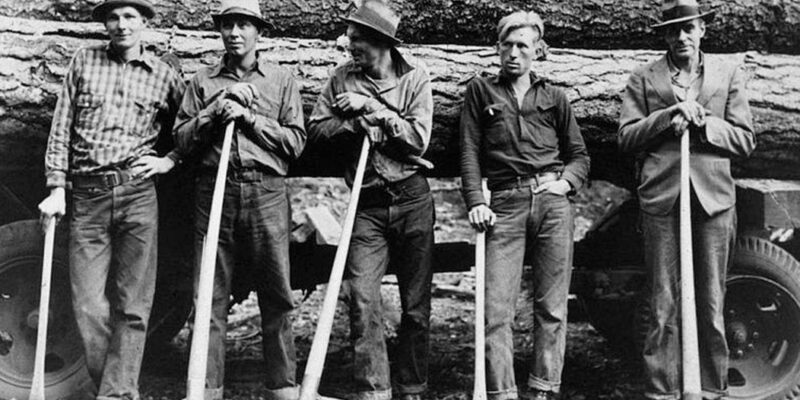
The typical 18th century aristocratic wear of excessive robes were intended to signify, purely in the form of encumbering clothing, how the wearer was above needing to use their own hands to perform anything but the most minor of tasks, for they had servants to do them. Workwear clothing is diametrically opposed to this, signifying the need to be able to carry out practical tasks. Denim jeans were initially introduced to America for labourers, such as factory workers and farmers. The durable yet flexible material allowed the workers to labour without encumberment or degrading their clothing. However, it didn’t take long for jeans to become universally worn across classes. Raw denim jeans are a particularly luxurious brand, which can cost multiple hundreds of pounds for a pair. What was once purely practical and signified an identity of “lower social strata” creates an opposing form. But rather than serving the function of the bulky and cumbersome dress of the 18th century aristocrats, to show how they were beyond labour, even expensive jeans signify “I am a practical person.”
We see this further in the workwear brand Carhartt. Originally founded to serve labourers with durable clothing to facilitate work, they are now essentially a fashion, rather than workwear, brand. Even the terms “workwear fashion” seems to be a contradiction, where “workwear” means practical clothing worn for facilitating labour and “fashion” means clothing wear purely for its social and aesthetic function. But precisely the desire to signify practicality becomes a fashion itself. The rise of “workwear fashion” ironically seems to correlate with deindustrialisation in the West. Since the 1980s, countries such as the US and UK have moved away from the primary and secondary sectors, the production of raw materials and manufacturing of goods, and towards the tertiary or service sector, the production of immaterial goods and services.
When considering the various hobbies which serve to hold social values, it may strike us as arbitrary which ones become popular: baking, gardening, pottery, sewing. However what is notably missing from these are precisely ones which are still essential to daily functioning and not supplanted by industrialisation and mass production, IE: plumbing, electrician. Even though it would likely be more useful in our everyday life to have a basic knowledge of electrics (rewiring, changing fuses etc), precisely because of its utility it does not hold the same social value, although it will be conceded there is a new trend of hobbyist electronics repair. It would be absurd to suggest waking up at 5am to prove a dough to put inside the expensive breadmaker you have purchased is economical, compared to the simple task of buying bread in the supermarket, especially when you must buy the yeast and flour anyhow. By “economical” however, I do not refer to the price or money expended but rather the time expended. Which refers to another so far unmentioned aspect of Material Necessities transfiguration into Social Signification. The ostentatious signification of surplus time. To signify one’s social class, it is beneficial to make known the amount of free time you possess.
Here we witness a kind of inversion of Thorstein Veblen’s Theory of the Leisure Class. Whereas the bourgeoisie of the late 20th century flaunted their excess capital through both: Conspicious Consumption, spending on luxury goods, (not only clothing, jewels, expensive works of art, etc, but also the employment of superflous servants) and Conspicious Leisure, “calls, drives, clubs, sewing-circles, sports, charity organisations, and other like social functions” (note that in sewing-circles the sewing is often for charity, sewing blankets to donate to the poor and the like), in the late 20th and early 21st century, Conspicious Production has largely supplanted Conspicious Leisure: even the wealthiest proclaim to work 80-hour weeks and often dress modestly.
We see a related movement in the form of housing. Of course, you only have to visit any one of the numerous palatial estates across the globe to know that housing as an item of social signification is not exclusive to the contemporary period. However, importantly, it is no longer the quality, the location, the size, the interior design, of the house which is key, but the quantity, not merely in the sense of second homes, but in the sense of possessing a housing at all. To pass from the condition of renter to owner is to be inducted into an exclusive realm. The signification here lies merely in the ability to accrue enough wealth (and/or to be gifted it from family) to pay the deposit for a mortgage, an act which is becoming increasingly difficult, nigh impossible.
To live transiently, travelling and renting rooms in inns while looking for seasonal work, used to be the realm of the pauper. Now only the rich can afford such a luxury.