We are witnessing and have witnessed, at a breathtaking pace, the dissolution of traditional cultural and cognitive structures in society. Capitalism abhors limits, and will take up any means or method in order to overcome them. Whether that limit be class antagonism, the gold standard, human bodies, or families. The result of these overcomings is a shockwave which echoes throughout society and resonates in every cultural space. What often appears as the revolution of technology is in itself a technological-revolution-for-capitalism. Relative to comedy, we may consider three dichotomies: the sincere vs the ironic, the public vs the private, the immediate vs the mediated. Each of these categories, whether considered innocent bystanders or targets in themselves, have suffered significant, perhaps even fatal, wounds at the hands of capital.
As Alfie Bown highlights: “Jela Krecic has argued that the function of comedy in society has fundamentally shifted within the last 20 years”. Quoting Krecic directly: “for thousands of years comedy has played a function of relieving tension but now in 2022 […] comedy has become the source of tension.”
This is a trend which is often overlooked and whose outlining provides a lens through which to understand cultural and economic changes in society. This essay will build on this illumination. We can take the examples of some recent phenomena on TikTok in order to critique what this essay names “post-comedy” further.
Bown also highlights the importance of Mikhail Bakhtin’s writing on comedy, specifically how his concept of the carnivalesque: “humor can function as a kind of ‘safety valve’ – appearing to be a carnivalesque destruction of norms but in fact serving to allow those social codes to maintain their hold on the social group in question.” However it is important to place Bakhtin’s writings within the historical context of the mid 20th-century, where most societies, whether communist or liberal democracies, were still governed by politically and economically centralised systems – especially evident in the structure of wartime economies. The moral norms which comedy targets can be understood through the lens of soviet secularity and western liberal values respectively.
However, due to the hegemony of neoliberalism from the 1980s onwards, there has been a radical “decentering” of moral norms and collective values. There is no longer “the truth” but merely “my personal truth”. Comedy depends upon a stable structure of moral norms and values in order to know what it is transgressing. This is one reason why religion so frequently serves as a great source of comedy – there are literally texts which explicitly state the norms which serve as opportunities for transgression. Both the pseudo-religious ideologies of so-called “social justice warriors” and right wing ideologies such as MAGAism (literally “God Emperor Trump”) can also provide norms for transgression, but the instability (or rather, flexibility) of each of these ideologies often render them inadequate objects for comedy in practice.
As we are more and more individualised, fed content individually curated for ourselves through social media algorithms, no longer watch the same TV, film and read the same books (if we read at all), there is no longer a “center” at which a comedic critique can be levelled. So what remains?
In February 2024, Tiktok user @julesandthevibe posted a video in which she, in a deadpan manner, claims that “countries in Europe do not have more differences than states in America”. A repost of this video received over 5 million views and 2,344 quotes on Twitter. Many users responding to this video took it at face value and lambasted her “ignorant American” view. However, they did consider that this may merely be a comedic performance, reminiscent of Andy Kaufman. The Tiktok user’s bio reads: “A jester of sorts. Comedian” Of course, a fraction of users will have clicked through to see this in the bio, or realised it is merely “bait “. But many more users will have seen the video disseminated on other platforms and not even have the opportunity to realise that this performance was ironic. But if we’re not laughing, what is this performance for? With past figures such as Twitter’s “bean dad” the ridiculing and shaming of figures was normally an unintended consequence of their actions. But what happens when a person is “playing the fool” and yet does not even need to signify as a fool? We can consider that this type of behaviour, this type of “comedian”, only becomes possible as a result of the dissipation of the barriers between public and private, and is therefore precisely a manifestation of that process.
Social media is not a stage. A stage provides a clear demarcation between audience and performer(s), between reality and theatre. The physical dimension of space allows us to cognitively map these separations. Social media has none of these. An audience in a theatre must be temporally and spatially copresent with the performers on stage. A social media user can view anything at any time from anywhere. Thus lies the dissolution of social barriers and therefore cognition. When Joe Rogan (or any comedian) makes a podcast, is it more like standup, or more like an interview? Is it both? As an audience, we no longer are provided with the necessary spatiotemporal context in order to map these experiences appropriately. Of course, the provision of context is only another barrier for capital to overcome (in the sense of the attention economy). Liberals may decry and vilify a comedian making wry remarks and punching down on the vulnerable – but this must be seen as a relatively rational response when comedians themselves are not seen as the jesters of yore, but rather, as social commentators who have supplanted the position that would have previously been held by public intellectuals.
Jordan Peterson has said that “[comedians] say what’s true”.This somewhat accurate, but remains simplistic. We should understand the truth-telling of comedians in the sense of the Lacanian aphorism that: “Every truth has the structure of fiction”.
Jimmy Carr and the Barbarism of the Holocaust Joke
We can take the example of Jimmy Carr’s abhorrent joke about Roma people and the holocaust to understand how truth functions in comedy.
The joke is as follows:
“When people talk about the Holocaust, they talk about the tragedy and horror of 6 million Jewish lives being lost to the Nazi war machine. But they never mention the thousands of Gypsies that were killed by the Nazis. No one ever wants to talk about that, because no one ever wants to talk about the positives.”
This was condemned by the Holocaust Memorial Day Trust, Hope Not Hate as well as members of parliament from both the Labour and Conservative parties. Representatives from the Traveller, Roma & Gypsy communities also spoke out against the joke.
Strangely, the right wing commentators who often claim that “comedians speak the truth” were incredibly eager to downplay the joke itself: “If you believe that joke is actually what Jimmy thinks, he is a monster. But he is joking and so it is not”. In line with the tradition of Freudian dream analysis (which Freud used to analyse jokes in Jokes and Their Relation to the Unconscious), we should not simply accept the manifest content of downplaying (and feigning support for) the genocide of Roma people as a joke without any underlying meaning. We should go further and ask the question which leads us to discover the latent content of the dream, or in this case, the joke. We must ask:
What mechanism has allowed the joke to take this form?
That is to say, what this joke reveals is which minority’s plight is still acceptable (and even profitable, as Carr’s special remains hosted on Netflix) in society to mock. This is not to say that the joke was not abhorrent nor that it is even acceptable, but rather, that the comedian’s capacity to reveal truths is often precisely because of their own ignorance, similar to how the analysis of the analysand’s dream can reveal meanings and truths which otherwise remain hidden to them.
As Grace Claire O’Neill, campaigner for Gypsy, Romany and Traveller rights and representation, stated in the Guardian in 2020: “[the Conservative government’s manifesto] contained a notable plan for legislative powers to create a new offence of ‘trespassing whilst setting up an unauthorised encampment’, which would give police the power to arrest and seize the property of Gypsies and Travellers. When your property is a caravan that serves as your home, this cannot be seen as anything but an attempt to erase us from existence”. (This later became law through the Police, Crime, Sentencing and Courts Act 2022.)
We can see here a connection between culture (comedy) and governance in the symbolic order. Within the realms of (British) entertainment, politics and legislation, oppression of and discrimination against Romani people remains (demonstrably) acceptable. This should not be in the case in any society which regards itself as liberal, democratic, or even simply human.
So, through his own ignorance, the ignorance of the comedian/jester/fool, Carr revealed in entertainment simply what was already accepted in politics and law. (What is transgressive about a joke that takes a position which is essentially held by the state itself?) The right wing perception of comedy as mere manifest truth or as “harmless fun” failed to realise the latent truth, but even the liberal stance of a rejection of transgression in comedy falls short of acknowledging that this heinous statement didn’t come from a vacuum or just an errant individual, but is rather a symptom of the structure of society itself. We may conclude that, due to the dissolution of societal norms, the transgressive desire of comedy means that the comedian may turn towards the barbaric in order to provoke.
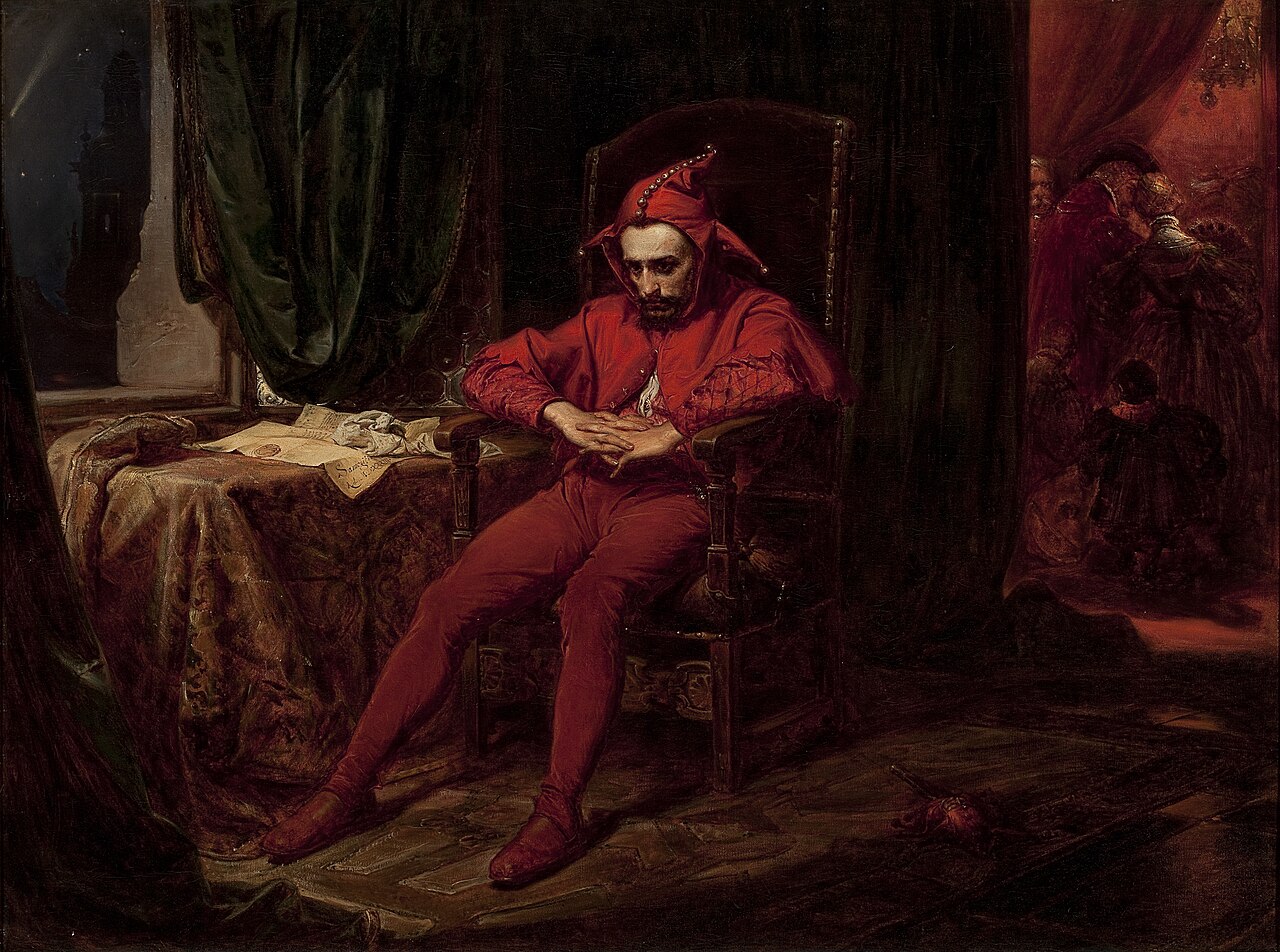
Before we return from the discussion of the destitution of comedy on stage to the post-comedian on social media, we should consider a historical version of the comedian: the court jester or fool. Historically there have been two types of fool: the “natural” fool and the “artificial” fool. The artificial fool is what we would today consider as a comedian, someone feigning ignorance and stupidity for the sake of humour. However, the natural fool was likely someone who had what we would today refer to as learning or mental disabilities, who in the mediaeval and renaissance were often cruelly laughed at. What we see today is something completely separate from the two fools, however. A type of “artificial natural fool”,where, due to changes in technology and social structures, someone can “play” a “natural” fool, pretending that they are not pretending to be foolish, rather than pretending to be foolish or being naturally foolish.
The Political Economy of Social Media Engagement
Just as capital does not care from whence its profit comes, the social media algorithm does not care from whence its engagement comes. In Marx’s analysis of the commodity in the first volume of capital, he notes that the two elements of a commodity are “use value” and “exchange value”. The use value is particular to each commodity and what sets each commodity apart, whereas, exchange value is what renders all commodities commensurate, hence: “as use values, commodities are, above all, of different qualities, but as exchange values they are merely different quantities”[1]. We can use this qualitative/quantitative distinction between use values and exchange values to understand the nature of engagement on social media.
As a consumer of social media, we may derive many different use values from the content we consume. It may serve to stimulate us intellectually, entertain us frivolously, allow us to bond with friends and strangers, or enrage us. But on the side of production and the realisation of profit, the prioritisation of a certain use value over any other becomes irrelevant when the augmentation exchange value (the extraction of surplus value) is the goal. Engagement is merely an abstraction of the user activity through which social media platforms profit, as more watch time equals more opportunities to sell advertising and therefore extract surplus value.
We must consider the “black box” nature of algorithms utilised in social media. The idea of the “black box” is essentially that, in using machine-learning to understand what kind of content users tend to consume the most of, the purveyors of any social medium are “blind” to what it use-value (and affects) it tends to prioritise. (There are exceptions of course, if the content violates the Terms of Service for example.) In a sense the decision of what type of content to serve to users is outsourced to programs rather than manually curated. In traditional media, curation generally occurs in a top-down structure, for example, a programming executive in television will decide the types of programmes their television channel shows, or a museum curator decides what to exhibit. In social media, curation occurs at a more bottom-up (dare we say rhizomatic?) structure, in one sense, with the user’s behaviour directly affecting the type of content they will be presented with. The metrics used for engagement on TikTok include videos liked, commented on, who you follow etc. However, the primary metric seems to be “the amount of time you linger over a piece of content” to quote a Wall Street Journal investigation. Essentially this cuts out the “middleman” of curation between the content producer and the content consumer. (The cutting out of middlemen is one of the many methods capital seeks to overcome limits, also exemplified by Uber’s decentralised taxi service structure). But, of course, people don’t tend to linger only on content they enjoy. The Wall Street Journal has also noted how teenagers using TikTok have been inundated with content promoting eating disorders and self-harm.
In the sense of comedy, what this means is that the target, or measure of success for comedy, has changed. When a stand-up comedian performs in a club, they can directly see and hear the responses to their quips. For a TikTok creator, they no longer have coprescence, meaning their audience is abstracted into metrics, both in the visible form of likes and the invisible measure of engagement (time spent watching a given piece of content). A comedian who fails to induce laughter in an audience is unlikely to be invited back to the club or even to remain in the job for long. If a TikTok comedian fails to make an audience laugh, however, this is no longer necessarily an issue – as long as the audience keeps watching.
To return to the example from TikTok user @julesandthevibe, we see a type of “artificial natural fool” as mentioned above. She explicitly states in her bio that she “make[s] money off the engagement”. No longer does a comedian have to be concerned with producing a certain affect (laughter) but simply any affect which drives engagement. (This is not to say, of course, that comedians have never seeked or produced effects aside from laughter – but laughter nonetheless has generally been the priority historically). This decoupling of the comedian from laughter means that anger, derision, mere curiosity, a feeling of superiority over the performer and many other forms can take priority over the inducement of laughter, facilitated by the split between the performer and audience through the abstraction of engagement metrics.
The fact that this engagement is merely a reflection of the activity of the user, however, does represent a type of Gordian knot with regard to explaining its ideological function. How can something which is a mere reflection of the user’s desire, with no top-down dictation, be ideological? Adorno and Horkheimer can lend us a sword to slice the tangled fibres and free the oxcart: “The [culture] industry submits to vote which it has itself inspired.”[2] We can always be told as “free” consumers of social media that we are merely choosing out of our own free will, voting with our engagement, what the algorithm delivers to us. But if the forms of the content we are provided are brief video clips which algorithmically have been incentivised to be immediate and simplistic, we will never be provided the opportunity for emancipatory negation, the encounter with the Other. This false democracy (as if there were any other sort) is what facilitates the defanging of comedy’s radical potential. The new impoverished “post-comedy” provided by social media no longer possesses the ability to critique the social totality, but rather, simply enforces the status quo by providing the user with a sense of false superiority over the “artificial natural fool”.
The TikTok user @malfoy_drayco has garnered tens of millions of views through documenting his experience of Paris, and it functions in exactly the way discussed prior. He sardonically complains about the tourist traps and dirtiness of Paris, ridicules the food and presence of American fast food chains, and, predictably, criticises the Eiffel Tower as overrated and aesthetically unappealing. What this offers the viewer, however, is not the opportunity for cathartic laughter, except in the form of derision at the “stupid uncultured American”. We are ushered into the comfortable seat of the armchair expert, either feeling (falsely) superior towards the foolish tourist or “joining in” with the ridicule against the European capital. Whether the TikTok creator is genuinely stupid or simply pretending to be a fool is beside the point, since either reality functions exactly the same in practice. Rather than utilising the power of comedy to critique and challenge our prejudices, this “post-comedy” solely functions as an opportunity to reinforce our prejudices and our worldview. The ideology here lies in post-comedy’s inability to, due to being an impoverished shadow of comedy, function as anything other than the reinforcement of the status quo. There is no opportunity to break out of our idiosyncratic perspectives, only the opportunity to entrench ourselves as isolated judges and spectators. To quote Adorno and Horkheimer again: “The result is a constant reproduction of the same thing.”[3]
Louis C.K on the Homeless
As a means of illustrating how comedy still has the potential to allow us to confront the taboo and profane, we can consider some of the jokes made by Louis C.K on his “Louis C.K. at the Dolby” special:
“There’s places where you’ll never see a homeless person, like the airport! There’s no homeless people at the airport. […] You’ve never been at your gate and there’s a person who’s like ‘Hey man, I’m trying to get to Tokyo, can you help me out?’”
This is, of course, a crude and vulgar joke. But what’s interesting is how Louis C.K rejects both the typical liberal and conservative stances towards the homeless. For the liberal, the homeless are deserving of sympathy, but this sympathy rarely extends to the level of willing to confront social reality. It remains the purview of charity and voluntarism to solve the issue, rather than situating the issue of homelessness within the wider economic reality, of a housing market designed to serve exchange values over use values, for example, and therefore, sympathy keeps praxis in stasis – to donate to charities, to give change to the homeless, these are of course both good things to do, but, for the liberal, we are not allowed to confront the economic reality which facilitates the deprivation of the basic human right of access to shelter.
For the conservative, homelessness is equally seen as an issue, but often is confined to the level of the individual: they are simply unfortunate. The suffering of the homeless is seen as merely the “cost of freedom”: the necessary suffering paid for by humanity in order to maintain the liberty of the free market.
It’s easy, at first glance, to perceive Louis’ joke as “punching down”, but what he is actually doing is rejecting both the stances of liberal sympathy and conservative cynicism. As opposed to the liberal stance of sympathy, which patronises and infantilizes the homeless, Louis puts the homeless people on equal footing with the audience, directly implicating both himself and the audience by stating: “They’re not allowed in the places we’re allowed, that’s what we all agree on.” Through the disarming ironic deadpan delivery, Louis is able to confront a brutal social reality through comedic means. We are all implicated in a society which restricts where people are able to go – and therefore their freedom – based on their access to exchange value. Which is why the airport joke is such a great example. Rather than seeing the deprivation of the homeless as a mere “economic externality” as the conservative may, he goes beyond the cognitive impediment of cynicism by illustrating how only those with disposable income are able to access holidays and therefore those are the only types seen in airports (aside from the workers). So rather than an airport being a “neutral” space which is merely a means to travel to other countries, Louis allows us to see that it is a place where there is a spatial negation of the homeless, the absurdity of which is embodied by the joke of the homeless person begging to get “two tickets to Tokyo”. Rather than simply being neutral citizens enjoying air travel, Louis C.K forces us to confront the fact that economic privilege and deprivation is present everywhere, even in seemingly neutral spaces like airports.
References
[1 ] Marx, Karl. Capital: Critique of Political Economy Volume 1. (Penguin Random House UK, 1990)
[2, 3] Adorno, Theodor W. Horkheimer, Max. Dialectic of Enlightenment. (Verso, 1997)